Correct Answer: A
Explanation:
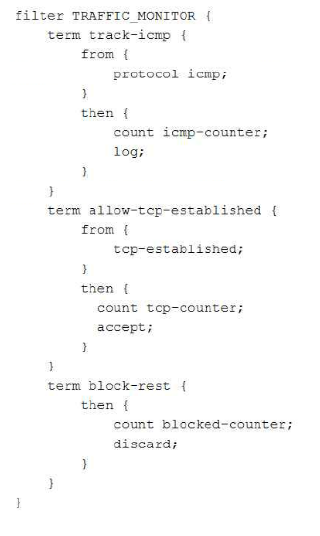
Junos firewall filters evaluate terms sequentially from top to bottom, and a term is only terminal for a packet if its then clause contains an explicit terminating action such as accept, discard, reject, or next term without a match. The count and log actions used in track-icmp are non-terminating; they update statistics and generate a log entry but do not stop evaluation, so a matching ICMP packet falls through to the next term after being counted. The second term, allow-tcp-established, matches only TCP packets carrying the ACK or RST flags as defined by the tcp-established keyword; an ICMP echo request does not satisfy protocol tcp, so this term is skipped entirely and does not accept the packet. Evaluation therefore reaches the implicit catch-all term block-rest, which has no from conditions and matches every remaining packet, incrementing blocked-counter and discarding it. The net effect for the described ICMP ping is that icmp-counter is incremented by the first term, the packet is neither accepted nor rejected by the second term, and blocked-counter is incremented immediately before the packet is silently discarded by the final term. This layered-term behavior, where counting is independent of the accept/discard decision, is a frequently tested nuance of Junos firewall filter processing logic. Reference topics: Junos Enterprise Switching -- Layer 2 Security and Firewall Filters, Filter Term Evaluation Order.